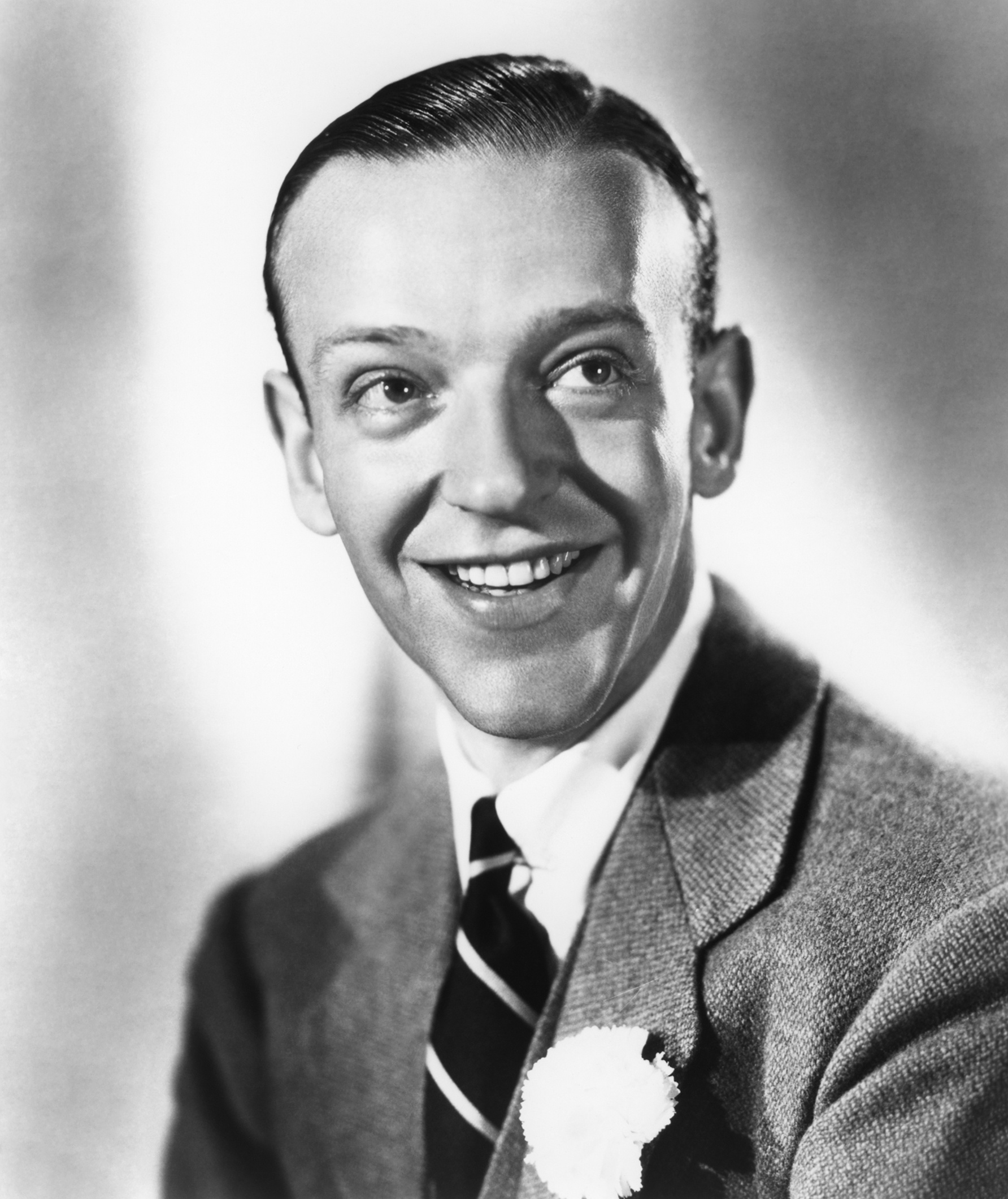
Post number 300 on Lolita's Classics deliver no less than a previously unknown photo of Fred Astaire in dress. RKO recently let go of this shocking portrait of the celebrated dancing actor.
According to a press conference held last week, Astaire himself prompted on posing in his favorite dress for a publicity still. The green and golden gown had previously belonged to his regular film partner Ginger Rogers, who obviously knew about Astaire's fascination for women's clothes and gave it to him as a birthday present.
The impressive rack was manually added to the photograph afterwards, also on request from the dance god himself.
Was Fred Astaire a transvestite, or was this photograph just a result of a crazy whim? We will probably never know, but you can read various theories and more about the subject here and here.
A site dedicated to fascinating secrets like these lies high on my recommendation list.
Lately I have been most too masculine in my choice of films, so I felt I had to watch a Fred & Ginger picture to remind myself and my readers that I am, in fact, still a lady.
I have a DVD box set with four of the couple's RKO pictures, bud sadly this one is not included. Therefore Swing Time was a new experience for me. A lovely experience, in fact, and I think it for the time being is my favorite Fred & Ginger film.
The plot is quite similar to Top Hat (1935) - but who cares about the plot in films like these? Oh, you do? Me too. But it's no disappoinment, the similar factors are those you don't care about anyway. Like re-using actors: if you like the actor, why complain that they have similar roles in another picture? Nice to see more of them.
I'm talking about the refined, eccentric and lisping Eric Blore and the middle aged, urbane cool older friend of the leading lady, Helen Broderick. Broderick even appeared with Astaire on Broadway with The Band Wagon!
Then we have the essential slimy Italian, this time played by Romanian actor Georges Metaxa. He has that kind of a role that Ginger for some reason always ends up almost marrying, because Fred has let her down in some way. In Top Hat she misunderstood him to be already married, in Swing Time she finds out he already has a fiancée. Good enough reason to take a pause from Fred, but why throw yourself in the arms of greasy narcissists? I think she need a few lessons in womanhood.
That much for the plot. I'm confusing, I know, but I don't find it important enough to straighten out (plus you all have probably already seen the film). Now to the good stuff!
The songs are wonderful. Fred sings "The Way You Look Tonight" while accompanying himself on the piano and Ginger washes her hair. (With whipped cream, from what I read in the trivia section on IMDb.) They both sing the jolly "Pick Yourself Up" during a dance class. Fred gives a minstrel show singing "Bojangles of Harlem" with three giant shadows dancing behind him. Itäs all very entertaining and joyful.
But my favorite part of Swing Time is the winter section, with heavy snowflakes filling every inch of the screen. Ginger gets disappointed when she tries to have a romantic moment with Fred, but the fact that he is in love with one woman and engaged to another (without any of them knowing it) destroys his sense for romantic settings.
They sing "A Fine Romance", a song I only have heard Marilyn Monroe sing before, and it's such a lovely scene. The camera work is perfect; the snowy landscape seems almost unreal. (Maybe it was? Was it filmed in a studio? All I know is that winters in Sweden can look just like that, and it's wonderful.)
I hope I look as cute as Ginger Rogers do when I'm angry.
The last scene is simple but superb. That hysterical laughter everyone breaks out into has to be for real, I can't believe anyone can fake such a thing. (For is it anything that really enoys me with feel-good films is that fake laughter the actors are forced to squeeze out, it's unbearable.) I guess it was the last scene filmed, and everyone was tired and silly. That's my explaination. And even if it was fake it got to me, and I found myself with a creepy smile by the end of the film.
I guess there's a lot of glamor in the morning routines of every beautiful actress.
There was however no glamor surrounding me this morning, after only one hour of sleep. Because of the lack of beauty sleep, I am now so distraught about the bags under my eyes that I simply have no inspiration to watch a movie and write a review about it. You will therefore have to do with some more pictures from my hard drive, and pretend that I look as glamorous as they do.
Stage Door is a fast-moving drama/comedy about a boardinghouse full of women waiting for their big break as actresses. The dialogue is quick and snappy, so this is probably one of those movies that only gets better with every time you see it!
They say that Gregory La Cava was a "woman director", and I bet you have to be really gifted to handle this crowd of big and promising actresses go, not making the film confusing. And it really manages not to be - the fact that all cthe haracters are interesting and take almost equal amount of space in the film is brilliant. You feel the cat claws in the air when Linda (Patrick) and Jean (Rogers) snap cleverly at each other, the clashing personality differences between the roommates Jean and Terry (Hepburn), and the dejected cynicism among the rest of the girls, with a stunningly beautiful Lucille Ball in the lead. The fact that Ann Miller managed to fake a birth certificate to get the role (she was only 14 here!) and pull off the dancing scenes with Rogers as an equal is simply admirable.
Scene: 14 year old Ann Miller and Ginger Rogers doing their dance routine. A slimy Adolphe Menjou keeps his eyes on the blonde one.
Hepburn, Ball and Rogers.
And after C. K. Dexter Haven's constant lovestruck babbling about Gail Patrick [see here and here], I have come to aknowledge her too - so cool, down-to-earth and charmingly insulting. (I have to admit that I think she manages to steal every scene from the melodramatic Carole Lombard in My Man Godfrey, 1936, and that is something to admire!)
And Adolphe Menjou! I always thought he was such a gentleman, but what an unsympathizing upstart he was as the producer Anthony Powell! I felt sick when seeing how he did "his routine" on the hopeful actresses - inviting them to his flat, giving them champagne, turning off the light, talking about how their names are going to be written in lights... Aweful! And amusing.
Gregory La Cava was nominated for an Oscar for Best Director and Best Picture, and the screenplay got a nomination too. I can't really see why they didn't win. (I can't believe Hepburn wasn't nominated for her "The calla lilies are in bloom again" rehearsals! It can't be easy for a good actress to play a bad one.)
Quotes:
Terry: I see that, in addition to your other charms, you have that insolence generated by an inferior upbringing.
Jean: Hmm! Fancy clothes, fancy language and everything!
Terry: Unfortunately, I learned to speak English correctly.
Jean: That won't be of much use to you here. We all talk pig latin.
Jean: Do you mind if I ask a personal question?
Terry: Another one?
Jean: Are these trunks full of bodies?
Terry: Just those, but I don't intend to unpack them.
Eve: [after a dinner where Terry Randall has evidently spoken very eloquently about Shakespeare] Well, I don't like to gossip, but that new gal seems to have an awful crush on Shakespeare!
Susan: [jokingly] I wouldn't be surprised if they get married!
Mary Lou: [with genuine naiveté] Oh, you're foolin'! Shakespeare's dead!
Susan: [Feigning surprise, playing along to entertain the others] No!
Mary Lou: Well, if he's the same one that wrote "Hamlet", he is!
Eve: [playing along, too] Never heard of it.
Mary Lou: Well, certainly you must have heard of "Hamlet"!
Eve: Well, I meet so many people.
Eve: A pleasant little foursome. I predict a hatchet murder before the night's over.
The character that probably fascinated me most was Kay Hamilton, played by the Olivia De Havilland-lookalike Andrea Leeds. (Two years later she read for the part of Melanie in Gone With the Wind, a part that went to De Havilland.)
Kay plays an actress, who already had her success and is now forgotten. She has gotten her eyes on a part in a new play and puts all her energy in getting the part (at one point leading her to faint of exhaustion and malnutrition), but that part goes to Hepburn's Terry Randall.
Andrea Leeds received an Academy Award nomination for her performance as Kay, well deserved.
When I saw her in Stage Door I was so fascinated with her acting, that I simply couldn't understand why I hadn't heard of her before. She was obviously a pretty popular actress in the late 1930's, but she left her film career in 1940 to become a housewife. I think the motion picture industry really lost something there.
Or at least, a little appetizer for what's yet to come.
Yesterday I finished my first video review in the form of a top 10 list. And what's the subject? Hollywood kisses, of course! Please let me know if it's satisfactory.
And happy birthday, Barbara Stanwyck and Ginger Rogers!
I have never had anything that I can remember in the business - and that includes all the movies and the stage shows and everything - that I didn't enjoy. I didn't like some of the small-time vaudeville, because we weren't going on and getting better. Aside from that, I didn't dislike anything.
- Fred Astaire
(As requested by Millie for winning my competition! Of course you can't write about Fred Astaire without including any film clips of his dances, but I decided to put them at the end of the post to avoid messing up the text too much. I write "film clip" in parenthesis when I mention something that will appear later on in one of those clips.)
Fred Astaire was an American film and Broadway dancer, choreographer, singer and dancer. Popular for the optimistic, elegant gentleman he played in many films, he had a long career stretching from the 1930's to the 1970's.
Fred Astaire was born Frederick Austerlitz in Omaha, Nebraska. His mother was born in America with German parents, and his father, working as a brewer, was an immigrant with Jewish ancestry from Austria. He had an older sister (b. 1896) named Adele Astaire (later Lady Charles Cavendish, moving to Ireland to live with the 9th Duke of Devonshire in the Lismore Castle).
Fred and Adele Astaire ca. 1906.
The family moved to New York City when their father suddenly became unemployed. The mother had, after discovering the natural singing and dancing talents in her children, had dreams about her children doing a brother-and-sister act in showbusiness. They changed the childrens names to Astaire, and made them take instructions in dance, speaking and singing. Fred and his sister had a successful vaudeville act in 1905, which eventually would bring them to the stage of Broadway in 1917, his sister Adele Astaire being the main attraction.
Fred and Adele Astaire, 1921.
By 1918 Fred's dancing skills were beginning to outshine his sister's, even though she draw much of the attention for her charm and sparkle. There success only grew bigger, and in the 1920's they appeared on Broadway with the popular George and Ira Gershwin musicals Lady Be Good (1924), Funny Face (1927), and in the next decade The Band Wagon (1931), the later bringin attention on both sides of the Atlantic.
Fred Astaire with George and Ira Gershwin (from left to right) in 1937.
After Fred did Funny Face he went to Hollywood for a screentest at the Paramount Studios, but were considered unsuitable for films. In 1932 he and his sister split when she married the 9th Duke of Devonshire and resigned from the show business.
The separation from his sister was traumatic for Fred, but it also gave him an opportunity to expand his range. In 1932 he starred in Gay Divorce together with Claire Luce, who inspired him to create a more romantic image. "Come on, Fred, I'm not your sister, you know", she is supposed to have said while dancing with him, resulting in the creation of a romantic partnered dance to Cole Porter's Night and Day. When film adapted in Hollywood with Fred and in the future returning dancing partner Ginger Rogers, The Gay Divorcee (1934) started a new era in filmed dance.
Fred Astaire with Claire Luce in Gay Divorce (1932), and with Ginger Rogers in The Gay Divorcee (1934).
"Can't sing. Can't act. Balding. Can dance a little."
That's a famous statement, said to have been spoken about Fred Astaire's screen test at RKO Pictures. Later that has been stated a folklore, and that the actual statement read:
"Can't act. Slightly bald. Also dances"
...which of course doesn't sound very optimistic neither. However, producer David O. Selznick commissioned the test and shared his opinion on Fred:
"I am uncertain about the man, but I feel, in spite of his enormous ears and bad chin line, that his charm is so tremendous that it comes through even on this wretched test."
RKO first lent out Fred to MGM to appear as himself, dancing with Joan Crawford in Dancing Lady (1933). The same year he made Flying Down to Rio with RKO, the first of ten pictures opposite Ginger Rogers. He got tremendous reviews, for example a journalist for Variety wrote following:
"The main point of Flying Down to Rio is the screen promise of Fred Astaire ... He's assuredly a bet after this one, for he's distinctly likable on the screen, the mike is kind to his voice and as a dancer he remains in a class by himself. The latter observation will be no news to the profession, which has long admitted that Astaire starts dancing where the others stop hoofing."
In his first screen appearance, with Joan Crawford in Dancing Lady (1933).
Colourized picture of the famous dance couple - Astaire and Rogers.
At first Astaire was reluctant to the idea of building a team with Ginger Rogers, since the partnership with his sister Adele, but he was convinced due to the audience's amazement of the two together. They're film musicals were enormous successes, including classics like earlier mentioned The Gay Divorcee (1934), Roberta (1935) (film clip), Top Hat (1935), Follow the Fleet (1936), Shall We Dance (1937) and Carefree (1938). Six of their RKO musicals became the studios biggest moneymakers. Astaire received a percentage of the film's profits, which was a very rare benefit at that time, and also got total control over the choreography and how the dances would be presented, giving Astaire the opportunity to revolutionize dance on film. For instance, he wanted his dance sequences to be filmed in one take, and keep the dancers in full view all the time. He also wanted the dance sequences to move the plot forward, interact them with the story line, and not only be pointless spectacles. The couple Astaire-Rogers was beyond doubt a crystal clear combination the audiences loved. As actress Katharine Hepburn said:
"He gives her class and she gives him sex."
Or as Astaire himself put it:
"Of course, Ginger Rogers was able to accomplish sex through dance. We told more through our movements instead of the big clinch. We did it all in the dance."
RKO publicity still of Astaire and Rogers dancing to Smoke Gets in Your Eyes in Roberta (1935).
Scene from the Astaire-Rogers film Carefree (1938).
In 1939 Astaire left RKO Studios to freelance and look for new film opportunities. Despite of the huge success his partnership with Rogers achieved he still didn't want to be tied to a partnership. His first dance partner after Ginger Rogers was the skilled tapdancer Eleanor Powell in Broadway Melody of 1940 (1940) (film clip). He also made two pictures with Rita Hayworth - You'll Never Get Rich (1941) and You Were Never Lovelier (1942). Their first film together brought Hayworth to stardom, and gave Astaire his first opportunity to experiment with Latin-American dance influences since that was something Hayworth was good at. In You Were Never Lovelier they sang the famous duet I'm Old Fashioned (film clip).
Eleanor Powell and Fred Astaire rehearsing for Broadway Melody of 1940 (1940).
Rita Hayworth and Fred Astaire.
Astaire also appeared opposite Bing Crosby in Holiday Inn (1942) and Blue Skies (1946) (film clip), but wasn't very happy with his characters always losing the girl to Crosby. More commercial successes was to come. Astaire worked together with director Vincente Minelli in Yolanda and the Thief (1945) and Ziegfeld Follies (1946), partnered in a famous scene with Gene Kelly (film clip).
Fred Astaire and the woman with the fabulous legs - Cyd Charisse - in The Band Wagon (1953).
In 1946 Astaire announced his retirement from films:
"I don't want to be the oldest performer in captivity . . . I don't want to look like a little old man dancing out there."
Audrey Hepburn and Fred Astaire having fun in Funny Face (1957).
After those films he actually more or less retired from film, but he did not retire from dancing. He made musical specials for televison in the late 1950's and the 1960's. The first of these programmes, An Evening With Fred Astaire (1958) won nine Emmy Awards. In 1968 he appeared opposite singer Petula Clark in the film Finian's Rainbow, directed by Francis Ford Coppola (director of the Godfather trilogy and Apocalypse Now), but unfortunately it was a box office flop. In 1974 he made an Academy Award nominated supporting role in The Towering Inferno, in addition to the Honorary Oscar he had received in 1950. Fred Astaire died from pneumonia June 22, 1987. His last wish was to thank his fans for their years of support.
The Towering Inferno (1974), with Paul Newman, Steve McQueen, William Holden and others.
A dance number from the film Roberta (1935) with Ginger Rogers: To Hard To Handle.
Eleanor Powell and Fred Astaire in a fantastic tap dancing sequence in Broadway Melody of 1940 (1940).
The famous dance scene under the moonlight, with Rita Hayworth and Fred Astaire singing I'm Old Fashioned in You Were Never Lovelier (1942).
A terrific step scene with Astaire from the film Blue Skies (1946).
A famous scene from Ziegfeld Follies (1946) with Fred Astaire and Gene Kelly singing The Babbit and the Bromide.I really think they improvised that dance.
Fred Astaire and Judy Garland perform A Couple of Swells in Easter Parade (1948). Peachy keen!
Two scenes from the classic The Band Wagon (1953) with Cyd Charisse.
And The Girl Hunt Ballet from the same picture. Paraphrase of the film noir genre?
Astaire dancing on the ceiling in Royal Wedding (1951), singing You're All The World To Me.
Audrey Hepburn expresses herself through the release of dancing in Funny Face (1957). I know that this is more av Hepburn's than Astaire's scene, but it is too wonderful to exclude. After all, her dancing is very "Astairy".


+poster+2.jpg)


_01.jpg)